Tuesday, May 21, 2013

New Photographs of Stafford and Friends During the 1950s

Kenny Johnson, William Stafford, and Bob Dusenbery
at Mt. Jefferson, 1958. Kenny Johnson Collection.
 
During the past few years the staff at the Lewis & Clark Special Collections have been processing William Stafford's immense collection of photographs (over 16,000 images). Most of these photos were taken by Stafford during his travels to poetry readings and writing workshops. The collection also includes various images of Stafford taken by other photographers. As one would expect, the bulk of these photographs were taken after 1963 when Stafford was awarded the National Book Award for Traveling through the Dark. 

Recently, Lewis & Clark received a gift that fills in some important gaps in the visual documentation of Stafford's life during the 1950s and early 1960s. Steve Johnson, the son of Stafford's close friend Kenny Johnson donated a small collection of slides that feature Stafford and the families of some of his closest friends including the Johnsons, Dusenberys, and Paulys. The image above shows Kenny Johnson, William Stafford, and Bob Dusenbery during a trip to Mt. Jefferson in 1958. The three men first became friends in 1948 when Stafford was hired to teach at Lewis & Clark College. The photo above hints at the intellectual camaraderie that the three shared throughout their lives. Scholars interested in Stafford's correspondence might be surprised at the lack of letters to other poets that include substantive intellectual discussions. The obvious explanation for this absence is that Stafford reserved this kind of discourse for his closest friends and colleagues in Portland. Stafford's correspondence with Kenny Johnson provides striking examples of the candor and intellectual banter between the two (the finding aid for this collection can be viewed at: http://nwda.orbiscascade.org/ark:/80444/xv55599/). Lewis & Clark College is excited to have this new slice of documentary evidence of Stafford's life during this period.

Jeremy Skinner
Special Collections Librarian, Lewis & Clark College


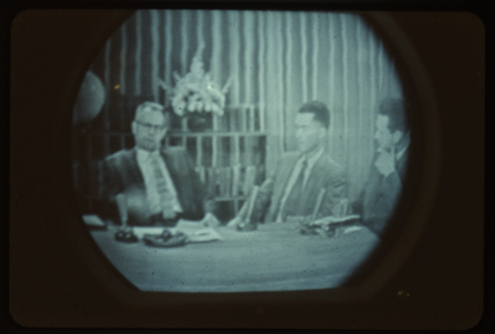
Photographs of a television broadcast on Portland's KATU station featuring Lewis & Clark English Department members. Top image (left to right): William Lucht, Kenny Johnson, and Bob Dusenbery. Bottom image (left to right): Bob Dusenbery, William Stafford, and Ted Braun. The broadcast was a special Christmas poetry reading in 1963. Kenny Johnson Collection.


Tuesday, March 12, 2013

“I like flat country” and “I hate precious poets;” How William Stafford and Charles Bukowski once met


An archives research project by Jessica Alberg,
Lewis & Clark College class of 2013


The room is hushed, candles line the isles of folded chairs and the light on the stage is strong so all attention lies on the man at the podium. He is in the middle of one of his poems when he pauses, takes off his glasses and looks up at his audience: "Do you ever get the feeling" he begins "that you'd go fucking mad doing a thing like this...maybe I will." The audience bursts into laughter.

Photograph of Charles Bukowski by William Stafford
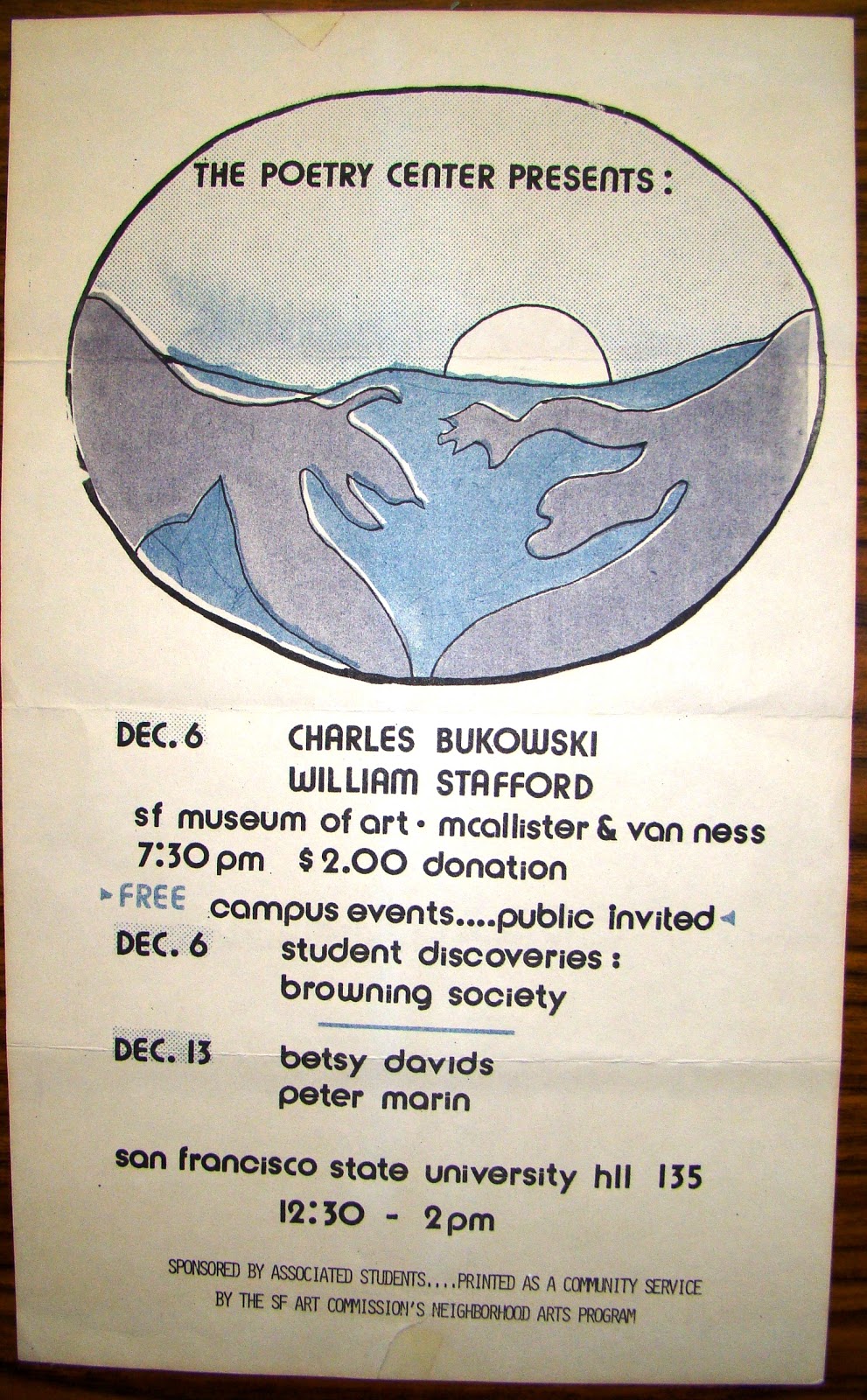
This is the poet Charles Bukowski during a joint reading where he and William Stafford presented poetry at the San Francisco Museum of Art at 7:30 pm on December 6th, 1973. Kathleen Fraser, director of the Poetry Center and the planner of this event explained her reasoning for placing these two together: "I like to hear different voices, different kinds of energies...People would see Stafford who otherwise would never have heard of him, and Bukowski would be introduced to a whole new group of people who would not have come just to see him alone." It was, without a doubt, an event charged on opposition. The event, Fraser later described "...was a mistake" and many considered the event to do incredible injustice to William Stafford. But while many in the audience considered it a mistake, Stafford and Bukowski may have thought otherwise.

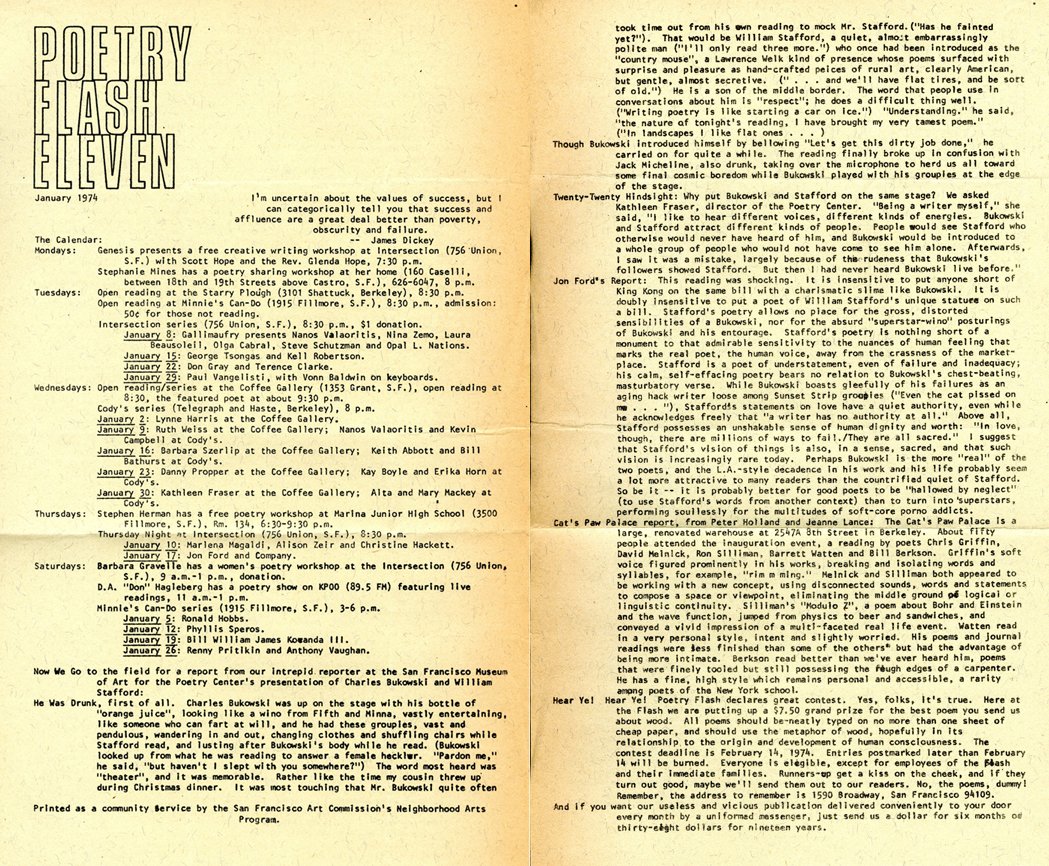
A review of the event by the newsletter "Poetry Flash Eleven"

William Stafford is considered to be a very accessible poet, one whose poetry is able to touch and be touched by a wide variety of people. "William Stafford is a poet of understatement" commented one reviewer of the event. During the event, Bukowski drank from an orange juice bottle containing more vodka than juice, mocked Stafford, and while Stafford read, the Bukowski groupies of the audience hissed at him. Bukowski attempted to insult Stafford during the event by insinuate that he was soft: "Has he fainted yet?" "Should I do as Mr. Stafford does and say: 'I have two more poems left?' [takes a drink] I'm just a nasty born drunk I can't help myself." Why insult the person whom you have agreed to read with? Bukowski answers this at the beginning of the reading: "I hate precious poets and I hate precious audiences too. They destroy each other."

Yet, as readers of William Stafford's poetry, we know that the irony of a Bukowski and Stafford reading was not lost on Stafford, at one point he remarked: "Understanding the nature of tonight's reading, I have brought my very tamest poem." He went on to read "Passing Remark":

       In scenery I like flat country.
       In life I don't like much to happen.
       In personalities I like mild colorless people.
       And in colors I prefer gray and brown.
       My wife, a vivid girl from the mountains,
       says, "Then why did you choose me?"
       Mildly I lower my brown eyes--
       there are so many things admirable people do not understand.

Stafford did not come unprepared to the Bukowski reading--he knew what he was getting himself into. His response to the wild and crazy nature of Bukowski was to bring his tamest poem. Something which, maybe unrecognized by the Bukowski fans, was a bold move. This poem, and the context in which it was presented, are bold because Stafford is choosing to do the opposite of what is happening--he is taking the harder path by creating more distinction between himself and Bukowski. "In life I don't like much to happen/ In personalities I like mild colorless people"--these lines seem to address Bukowski's idea, that those who are extravagant and untamed are more interesting than those who are subtle, "precious" or mild. It is easy to appreciate the mountains, it is not as easy to appreciate the flat country. "There are so many things admirable people do not understand." Stafford ends his poem in a way which speaks to more than the mildness of "colorless" people. There is something inside these people that, because they are mild, allows them to better admire what is vivid, what is appropriately admirable. They are picky in what they choose because they see the vivid maybe more clearly than those who do not appreciate the simplistic. In September 1980 Stafford received a letter from a farmer named John Budan, who opened his letter by remarking that he had seen Stafford: "I saw you in person once, in San Francisco and it was sad because you read poems with Charles Bukowski who was very insulting." Stafford not only touched they city dwellers of San Francisco during this reading, but as well a farmer who had come into town. That he was able to touch someone during a reading considered a "theater event" by some of the critics means that Stafford had a strong voice and though he did not have the the flamboyant and crazy attitude of Bukowski, Bukowski was not able to shadow Stafford. Bukowski drank a bottle of screwdrivers but Stafford stayed sober and managed not to lose control of a daft event. In a letter to Stafford from Fraser after the event, Fraser stated: "You are most generous regarding a most unusual, unexpected and, for me, overwhelming EVENT..." Stafford also read a poem he included in his book, Writing the Australian Crawl.

     We’d have an old car, the kind that gets
     flat tires, but inside would be wolfskin
     on the seats and warm fur on the steering
     wheel, and wolf fur on all the buttons. And
     we’d live in a ranch house made out of
     logs with a loft where you sleep, and you’d
     walk a little ways and there’d be the farm
     with the horses. We’d drive to town, and
     we’d have flat tires, and be sort of old.


Another, seemingly, mild poem about mild people.

Stafford wrote to Bukowski four days after the event. His letter is surprising but speaks to his character.


Stafford letter to Bukowski
Stafford's letter is simple but respectable. His description of the scene is: "...a swirl" as if the whole situation was overflowing, mixed up--a whirlpool of activity and event. It is what one would use in place of the word "blur." When Stafford is finally able to see clearly, Bukowski is gone (which may indicate that he was mixing and swirling the room). As well, it is clear that Bukowski took Stafford by some surprise by leaving before saying something: "I didn't think I'd miss a chance to meet a partner in a joint reading." His next paragraph, about the blurred picture is quite interesting as well. "I blame the lighting" is a reference to the candle light, which is highly problematic for someone attempting to take a photo. Stafford then does the polite thing of offering to Bukowski his favorite poem by him, a very polite and normal gesture. However, he also adds that he got it put into an anthology. Now the gesture has gone from merely one of politeness, to one in which he shows honest enjoyment for Bukowski's work. A high compliment indeed. His final note: "Good luck." is maybe most telling of all. This simple statement is almost warm--it seems to indicate a sense of compassion.

Charles Bukowski replied almost a month later.

Bukowski letter to Stafford

Bukowski's letter is truly opposite Stafford's letter, which is apparent from the first sentence: "You show excellent style in contacting the enemy." While in Stafford's first paragraph he calls Bukowski a "partner," Bukowski calls himself William Stafford's "enemy." But this is not with the intent of ill will, but rather just a funny way Bukowski saw it. Most of Bukowski's letter is hard to decipher, and takes great patience. But there are a two moments that, with regards to William Stafford, must be pulled out. The first is in Bukowski's second paragraph:

  ...what those in the poetry audience misunderstand...what those who rail against me and cheer you--we are both, somehow, on the same side, and that kindness is knowing whatever we can know and to put it down in the light of seeing. you say it one way, I say it another. but all we are asking is a chance to live. To live with blue slippers on our feet and sausages cooking over some flame. we don't even ask love. we are wiser than that.

What Bukowski points to here is something Stafford speaks to often in his poetry: The Truth, honesty, the poet recognizing the feeling of something and being able to follow it. A poet is honest when someone else would have been nice. As well, Bukowski is returning to his idea that while he and Stafford are "enemies," they are also on the same side by putting the truth into the light so that the audience can see it. What the audience cannot see is Bukowski and Stafford's connection. These poets are more connected than we as readers can seemingly see.

Bukowski's final paragraph seems to reveal to Stafford a very personal side: "it's just as well we hadn't met. I do things stupid. I am powerful but I am frightened," Bukowski says. This seems to be the most honest line of the letter. It was quite common for people say that they revealed to William Stafford things they never thought they would say, and it seems as if Bukowski was also pushed to say something. Right after this note he launches into made up words and strange sentences, and becomes impossible to understand--as if the moment before was too much. And of course, one cannot leave the letter without noticing the handwritten notes on the side and the drawings, no more than one can go without noticing that Bukowski has spelled his first name wrong. All things that seem to describe Bukowski, even from his signature introduced with merely a "yes" which was not a way he normally signed. It is not quite clear what the "yes" refers to, if it is to the "thank you for writing me" or to something in Stafford's own letter, such as the "good luck."

Both poets wrote honest letters, letters that were completely reflective of their character. Their letters not only show the difference between them, but also show the similarity between the poets. These letters, and this poetry reading, show us the connection of poets. How they, never mind what we as an audience think, "...[are] both, somehow, on the same side...[and] knowing whatever [they] can know...put it down in the light of seeing."


This is a video of Bukowski reading at the 1973 San Francisco event. It contains feed of almost every moment he is on stage. There is no surviving video of Stafford's portion of the reading. 


Thursday, February 21, 2013

New William Stafford Bibliography Available for Pre-Order


In August of 2012, Lewis & Clark College Special Collections staff completed the compilation and editorial work for the first comprehensive bibliography of the publications of William Stafford. This was a landmark achievement for our staff. Based on nearly fifty years of research began by James W. Pirie in the 1960s, the 544-page book provides bibliographic information for all known editions of Stafford's books, translations, editorial work, broadsides, serial publications, appearances in anthologies, archival collections, and a listing of major criticism. The book also includes a 100-page index of every poem title, book title, name, and publisher that appears in the bibliography.

This book is a must-have for Stafford scholars and anyone doing work in the Stafford Archives. Oak Knoll Press has announced that the book will ship in March 2013. If you would like to pre-order your copy, go to: http://www.oakknoll.com/detail.php?d_booknr=110070.

Special thanks is due to Robert Miller for his permission to use his stunning previously unpublished portrait of Stafford for the book jacket.

Jeremy Skinner
Assistant Archivist, Lewis & Clark College
Managing Editor for William Stafford: An Annotated Bibliography 


An Update on Work in the William Stafford Archives

The staff at the William Stafford Archives at Lewis & Clark College have neglected this blog for the past year while we have been working hard to finish a number of massive cataloging projects. While we apologize for our absence, we are happy to announce that most of our major projects are complete and all of our new Stafford research tools are accessible to the public.

Key among these new tools is the soon-to-be-released Stafford bibliography (see this posting about the book). Additionally, the entire 130 linear foot research collection is now searchable and browsable through online finding aids at the Stafford Archives website. The organizational chart for the entire collection can be seen below. 

We look forward to seeing you in the archives.

Jeremy Skinner
Assistant Archivist, Lewis & Clark College  


Series 1: Drafts, 1937-1993

  • Sub-Series 1: Daily Writings, 1950-1993
  • Sub-Series 2: Travel Journals, 1952-1992
  • Sub-Series 3: Documentary Copies, 1937-1993
  • Sub-Series 4: Prose, 1937-1993
  • Sub-Series 5: Writings for Public Readings and Workshops, 1960-1993
  • Sub-Series 6: Stafford’s Translations of Other Authors, 1962-1992 

Series 2: Professional Engagements, 1959-1993

  • Sub-Series 1: Appointment Books, 1959-1993
  • Sub-Series 2: Promotional Materials and Conference Programs, 1950-1993 

Series 3: Correspondence, 1958-2010

  • Sub-Series 1: General Correspondence, 1958-1993  
  • Sub-Series 2: Correspondence with Publishers, 1958-2010
  • Sub-Series 3: Civilian Public Service Correspondence, 1930s-1947 

Series 4: Photographs, 1880-1993

  • Sub-Series 1: Negatives of Photographs by William Stafford, 1966-1993
  • Sub-Series 2: Prints of Photographs by William Stafford, 1960-1993
  • Sub-Series 3: Stafford Family Photographs, 1880-1993
  • Sub-Series 4: Photographs of William Stafford, 1920-1993 

Series 5: Audio & Video, 1950-2012

  • Sub-Series 1: Video Footage of William Stafford, 1966-2011
  • Sub-Series 2: Audio Recordings of William Stafford, 1963-1993
  • Sub-Series 3: Musical Settings to William Stafford Poetry, 1950-2012
  • Sub-Series 4: Audio Recordings of Others Reading Stafford’s Poems, 1976-2009 

Series 6: Teaching Materials, 1950-1993

  • Sub-Series 1: Syllabi and Handouts, 1950-1978
  • Sub-Series 2: Teaching Notecards, 1950-1993

Series 7: Artifacts, 1943-1993

  • Sub-Series 1: Artifacts Owned by Stafford, 1943-1993 

Series 8: Publications, 1938-2012 

  • Sub-Series 1: Books by Stafford in English, 1946-2012
  • Sub-Series 2: Books with Contributions by Stafford, 1947-2012
  • Sub-Series 3: Periodicals with Contributions by Stafford in English, 1938-2012
  • Sub-Series 4: Broadsides Featuring Stafford, 1959-2012
  • Sub-Series 5: Translations of Stafford, 1970-2011
  • Sub-Series 6: Criticism of Stafford, 1957-1911
  • Sub-Series 7: One-of-a-Kind Art Books, 2011

Series 9: Pacifism, 1939-2006

  • Sub-Series 1: Pacifism Publications, 1939-1968
  • Sub-Series 2: Civilian Public Service Subject Files, 1942-2006 

Series 10: William Stafford Biographical, 1950-2012

  • Sub-Series 1: Biographical Clippings, 1950-2011  
  • Sub-Series 2: General Biographical, 1950-2012

Series 11: Stafford Archives Administrative Files, 1998-2012

  • Sub-Series 1: Topical Files, 1998-2012

Thursday, March 24, 2011

Japanese Students Illustrate "Malheur before Dawn"

Barbara Schramm writes:

Each year during their January interim I facilitate a three-day workshop with 30-35 Japanese students in the Academy of International Education program based in Osaka, Japan. These students are enrolled at St. Martin’s University and Pierce Community College in Lacy, WA. Students vary in their English speaking proficiency. One of the 5th year students acts as our translator.

In 2010, with encouragement and guidance from Paul Merchant, we worked with four William Stafford poems: “A Ritual To Read To Each Other,” “Ask Me,” “A Valley Like This” and “For My Young Friends Who Are Afraid.” You may review this work on Lewis & Clark College’s William Stafford Archives website (blog of February 25, 2010, under “Information”).

This year we worked with “Malheur Before Dawn” using the following reflection questions: Write about the title, what does it seem to prefigure? How does it work to assist the ideas of the poem? Choose one line from the poem and respond to it: What are your associations with it? What does it remind you of? What question does it ask or answer? Why did you choose this line? Which one word is at the heart or core of this poem? If you had to choose one word to represent the entire poem, which would it be? Explain your choice.

Students work in groups of four, writing individual responses then discussing in their small group followed by full group discussion. The students were asked ahead of time to bring a poem of their own choosing, including a short biography of the poet. We discussed these poems also and compared ideas from their excellent selections to those expressed in “Malheur Before Dawn”. We tied these ideas to Ekhart Tolle’s New Earth, a book they’d been required to read this summer during their annual 30 -day retreat in Hokkaido.

On the third day the students drew a “wood cut” illustrating the one line they’d chosen from “Malheur Before Dawn”. I’d shown them on a large screen Michael Spafford’s wood cuts illustrating Wallace Stevens’ s “Thirteen Ways of Looking at a Blackbird”, two wood cuts for each of the thirteen stanzas. Particular drawing paper and pens were selected in advance with advice from Art Media.

One of the students, Seijun Kanazawa, translated “Malheur Before Dawn” from English into Japanese. This is a student who is learning English as his second language! Hirotsugu Kawai, Miho Harada and Yosuki Oi, and a group of students from Steilacoom Hall wrote their own responses to “Malheur” in English.

The Directors of the program say that they’re amazed at the language learning that takes place during these three days.

My thanks to Paul Merchant for encouraging this project, Ann Staley for her help with the focused free-write questions, and to Takuya Otani, Director for his endless patience and good humor in coordinating all the details.

The students in this program were:

Shuhei Nagashima, Masato Nishida, Masaaki Hasegawa, Seijun Kanazawa. Takeshi Ono, Takanori Ito, Akira Oishi, Ikue Nomura, Miho Harada, Kyoko Shimozono, Yuma Kanai, Yosuke Oi, Ryota Mizutani, Tetsuya Yonetsu, Eriko Nekomoto, Mayumi Iwata, Takashi Fujii, Yuki Kato, Yasuyuki Shimada, Takuya Hashimoto, Hirofumi Kuroda, Maki Endo, Ayumi Mikuriya, Yuki Otsuki, Kaoru Fujita, Kokoro Iwano, Koshiro Ueda, Takumi Iizuka, Atsuhito Sekiya, Shingo Kojima, Ryoko Wada, Hiroko Momose, Kimiko Hakomori, Hirotsugu Kawai, So Sato, Makoto Yuasa.


Barbara Schramm, MA

Paul Merchant comments:

This project resulted in a remarkable collection of illustrations of "Malheur before Dawn," responding to almost every word of the poem. The poem and illustrations are reproduced here, together with a translation of the poem into Japanese by one of the students.

Here is the poem, “Malheur before Dawn,” by William Stafford. It was first collected in Holding onto the Grass (Honeybrook Press, 1992), and reprinted in Even in Quiet Places (Confluence Press, 1996) and The Way It Is (Graywolf Press, 1998):

Malheur Before Dawn

An owl sound wandered along the road with me.
I didn’t hear it—I breathed it into my ears.

Little ones at first, the stars retired, leaving
polished little circles on the sky for awhile.

Then the sun began to shout from below the horizon.
Throngs of birds campaigned, their music a tent of sound.

From across a pond, out of the mist,
one drake made a V and said its name.

Some vast animal of sound began to rouse
from the reeds and lean outward.

Frogs discovered their national anthem again.
I didn’t know a ditch could hold so much joy.

So magic a time it was that I was both brave and afraid.
Some day like this might save the world.

William Stafford

Here is Seijun Kanazawa's translation of the poem into Japanese:


Ryota Mizutani and Makoto Yuasa illustrated the first two couplets of the poem. Ryota's drawing has a splendid difference in scale between the owl and the listening poet, and Makoto has done something very imaginative in making the night sky a reflection of the dawn sky:

An owl sound wandered along the road with me.
I didn't hear it—I breathed it into my ears.

Little ones at first, the stars retired, leaving
polished little circles on the sky for awhile.


The next couplet was illustrated by fourteen students. First Maki Endo shows the sun's shout against the darkness:


Hirofumi Kuroda and Yuki Kato show two different ways of placing the horizon and of showing the relationship of light to dark:

So Sato (top left) takes a long view, while Ryoko Wada enters the landscape more intimately. Yasayuki Shimada and Yuma Kanai (bottom left and right) explore the sunrise itself in two very different ways:

Three more sunrises, by Masaaki Hasegawa (left), Shuhei Nagashima (center) and Mayumi Iwata (Right) express the whole range from naturalistic to abstract interpretation:

And now the birds have begun to appear, floating on the lake in Masato Nishida's drawing, or, in Hirotsugu Kawai's interpretation, forming patterns in the sky:

Akira Oishi and Kyoko Shimozono show the shout from behind the horizon itself, and Akira also showed the drake making a V and saying his name. Three students illustrated the following three lines:

Throngs of birds campaigned, their music a tent of sound.

From across a pond, out of the mist,
one drake made a V and said his name.


Miho Harada made music out of the flight of the birds, while Eriko Nekomoto placed the birds in musical patterns on a pine tree:


For the next two lines:

Some vast animal of air began to rouse
from the reeds and lean outward.

Hiroko Momose placed herself right in the reeds and imagined the vast animal, a lovely piece of understatement:


Four students enjoyed the next line:

Frogs discovered their national anthem again.

Seijun Kanazawa (top left, who also made the translation into Japanese shown earlier) and Takeshi Ono (top right) combine frogs and music, from a distance and close up through a magnifying glass, while Ikue Nomura (bottom left) and Takanori Ito (bottom right) group the frogs amusingly into singing choirs:


Three students, Shingo Kojima (left), Takuya Hashimoto (center), and Yosuke Oi (right) found ways ranging from peaceful landscape through a pattern of frog's heads to a flamboyant ditch of frogs in a forest to express the word joy in the following line:

I didn't know a ditch could hold so much joy.


William Stafford ends his poem with two ecstatic lines of acceptance and exhilaration:

So magic a time it was that I was both brave and afraid.
Some day like this might save the world.

Both Kokoro Iwano (left) and Ayumi Mikuriya (right) respond with appropriately peaceful landscapes:

These illustrations amaze me with their variety, wit, imagination, and presentational skill.

At a time of great tragedy in Japan, following the devastating earthquakes and tsunami, it is heartening to experience the sensitivity of these young peoples' responses to William Stafford's poem. We can be both brave and afraid, and I like to think that these students show the way to keep alive a creative spirit: "Some day like this might save the world."

Paul Merchant, William Stafford Archivist,
Lewis & Clark College, Portland, Oregon


Tuesday, January 11, 2011

Poem by Ruth Crowley

Kim was contacted recently by Molly Fisk, a good friend of our treasured associate Fred Marchant, poet and editor of William Stafford's early poems (Another World Instead). With Fred's encouragement, Molly was sharing a poem by her student Ruth Crowley, written in response to the New York Times obituary heading for William Stafford.

Ruth Crowley's poem, a rich and evocative response to the Times's slightly limiting headline, is printed here for the first time with her permission. Our thanks to her, to Molly Fisk, and to Fred Marchant.

William Stafford, Noted Regionalist, Dies
New York Times, 1993

Each morning before dawn he rose
to write. He listened to the dark, and what took root
was only his. Light hides a lot, he said. He teased
large questions from his daily tasks and shied at answers.

Not intertextual or urbane, his work
feels like plain speech, flat as the Kansas of his birth,
but look again how careful and compact,
how closely shepherded each word.

He fought the war as a CO. The pain of that.
Half Crazy Horse, half Gandhi, he sought the wild in us,
and in the wild our path. Isolate, who else would ask:
is this poem good--for the universe?

His region is the space between:
hand and hand, sky and ground, mind and mind.

Wednesday, September 29, 2010

Erland Anderson Remembers William Stafford

Poet and academic Erland Anderson , a frequent correspondent with William Stafford from 1975 to 1993, has sent us this memoir of their long association. His reminiscence ends with a revealing comment by William Stafford on his poem "Fifteen," the kind of information that usually goes unrecorded, and an interesting sidebar to Stafford's published account of the poem, reprinted in Crossing Unmarked Snow (1998). Dr Anderson's home page has two addresses, the easy to remember www.erlandanderson.com and the address listed in the document below.

Back and Forth: Los Prietos, Wendell Berry, Friends of Stafford, Friends of P. B. Shelley

Not until this January, 2010 had I managed to play a part in a William Stafford memorial celebration of his words. Thanks to Paul Willis of Westmont College, an outdoor reading was scheduled on a Saturday afternoon late in that month at Los Prietos, now a California State Park just over the Santa Inez Pass from Santa Barbara. California. Of course, that is the site of one of the camps where Stafford served as a conscientious objector during the Second World War, and where he met his future wife, Dorothy.

Recent Stafford scholarship has uncovered plenty of new material relating to his development as a writer and poet at Los Prietos, with a clear focus on his writing habits and stance as a witness to events big and small. Before the reading that afternoon, Paul took me for a walk and pointed out several rows of stones, which are the remains of barracks from the days of the CCC and later the CO camps. “Of course, it is also the former site of a Chumash Indian village,” he added.

Then Paul had me look across the arroyo, brimming this rainy year with smooth-flowing water, to the mountain opposite and uttered a line from one of Bill’s poems written at the camp and describing the multiple thin layers in those massive white rocks. (Here, if I had been so fortunate, I would have liked to quote that line, but, alas, my memory fails.) [Perhaps Paul was quoting the opening line of The Country of Thin Mountains: “I tell you, friends, the mountains here are thin—” (July 1942) or the phrase from Meditation: “some day, looking along a furrowed cliff” (March 1943), both now in Another World Instead, pp. 29 and 38—Ed.]

Where memory doesn’t fail me, especially when it comes to quoting Stafford, can be easily reinforced by the many treasured poems I have returned to as a reader and a teacher of his and others’ poetry over the last forty-two years. The multiple contacts—as a student, a reader, a fellow teacher, a correspondent back in the days of snail mail, a fellow poet, and workshop participant—would be too long to trace here, but a few anecdotes from my memories of the various colloquies I had with Bill might be of interest to those with whom I share a common inspiration.

Vince Mowrey, who also read at Los Prietos that day in January, helped to bring me up to speed afterwards by sending me the CD called Every War Has Two Losers, and then a copy of Kim Stafford’s book-length memoir, Early Morning. It was after re-establishing contact with Kim and sharing shorter versions of the following pieces via email that Kim suggested I try weaving them as a blog on the William Stafford Archive website.

Oh yes, Kim suggested I should talk “recklessly,” so I will try.

My very first contact with the work of William Stafford arrived as a package at my apartment in Seattle a month or so after I moved there in 1968 to begin my graduate studies in English. As an undergraduate at UCLA I had drifted from the study of History and Anthropology to Literature and Languages, and, though occasionally trying my hand at a sonnet or two, I saw myself as having a vocation to teach first and then do research and write whatever might come. My impression of “creative writing programs” at the time, I must admit, was not especially positive, and I stuck to the heavy-duty reading programs in multiple European languages emphasizing major writers and historical periods.

When I finally opened that package in Seattle, out slipped three slender books of poetry—two in hard back (Traveling Through the Dark, and A Rescued Year) one in paper (Allegiances)—sent to me by a cousin in Kansas, who some fifteen years later I would find out had been my birth-mother. (So these books, in hindsight, already fit into a pattern of “tokens” from which I might have inferred a closer relationship to this “country cousin,” but at the time the details of my adoption were a dark, well-kept, family secret.) Back in 1968, it appeared that she simply shared my interest in wide reading and wanted to offer me a link between her favorite poet and my new residence in the Northwest. And, sure enough, it wasn’t long after I read through those books, noting her check marks next to the poems she especially liked, that her “Kansas poet” was scheduled to read on the University of Washington campus.

Doing a little preparatory reading before I heard him read aloud, I could tell that William Stafford was a poet who offered words that resonated with a consciousness of current national and local issues both deeply troubling and deeply reassuring. Whereas my education at UCLA had provided a penchant for modernist irony, Ivor Winters, and the “New Criticism” (which was in fact quite old by then), the University of Washington seemed like a deep immersion in an endless variety of poets who gave frequent public readings, culminating every spring with one in memory of Theodore Roethke. His ghost, it was rumored, still walked circuitously through the corridors of Padelford Hall, prodding on the surviving scholars who were his friends: Arnold Stein, Robert Heilmann, Otto Reinhardt, Brents Sterling and my future dissertation advisor, Edward E.Bostetter.

Appropriately enough, Stafford’s reading was a modest affair, but it left an indelible impression on me. Not certain why, I was nonetheless hooked. His words had been clear and accessible on the page, but something he projected audibly in his reading revived the timbre of his voice afterwards each time I encountered any new poems by him wherever they appeared. In my graduate studies I was gravitating toward the English Romantic poets and quickly made the connection between strains of that tradition in twentieth-century American literature, which he, despite the deceptively plain surface of his work, seemed to have cultivated into a finely expressive art.

Furthermore, don’t forget that it was the late Sixties, and every other male student I knew beginning graduate school that year was likely to be drafted into the “war effort” in Vietnam. Having been raised as a son of a lieutenant captain in the Navy during World War Two, I was far from a protester as the war began in the early Sixties. My own “A Draft for Vietnam” from a later chapbook, A Hollow of Waves, and which is accessible on my website, www.erland-anderson.appspot.com, details my transformation from Goldwater Republican to ambivalent protester by the end of that decade. Consciously or unconsciously part of my decision to move to Seattle had to do with the proximity of the Canadian border if things came to boil, and I had grown increasingly interested in alternative service myself, attending meetings at the Friends’ Church and examining my own conscience. It was a time of crucial decisions and many had to make them in a highly charged era of “political polarization” and media hyperbole without much calm, reasoned discussion.

So it was helpful to have a witness to similar inner conflicts and convictions from someone from my parent’s generation who had added current insights in his ongoing production of recent poems. Unlike louder, less temperate voices of protest, Stafford got to the heart of the matter with his steady demeanor and wry sense of humor. Here was a role model, closer to my own temperament, for learning a way to tackle the circumstances and potential vocations in my life without succumbing to anger and despair. Eventually I was to learn that his pacifist religious tradition in the Church of the Brethren had been part of my Kansas heritage on my birth-father’s side at McPherson College, and like his own brother, Bob, my relatives had mostly chosen to part from their religious backgrounds and participate dutifully through military service in World War Two.

Over the years of our contact, I shared these distant connections of mine with Bill and I made sure to stay abreast of many of his poems and publications on teaching writing and literature. When I, myself, was offered a two-week Poet-in-Residence position in Junction City, Kansas, and the local paper published my poem “Drop Drill” from A Hollow of Waves, Bill sent me a letter right away, which I received when I returned to the Northwest, telling me that one of his friends or relatives there had sent him my poem and the photo of me reading at the high school. I often consider that poem to be a kind of “Song of Innocence” from a third grader’s perspective on the unimaginable threats of a nuclear holocaust—a horror humanity has managed to avoid up to the present perhaps because we keep reading, writing, praying, and singing in the manner of William Stafford.

All the readings and panel discussions that I attended and that he participated in during the period from ’68 to ’76 went into my “Continental Drift” from Searchings For Modesto. Also at www.erland-anderson.appspot.com. What impressed me the most was Bill’s ability to question the more academic poets, who often claimed that political poetry was too often written “from the gutter,” but also to frown, often visibly, at inflated rhetoric by others who departed too radically from the principles of non-violent protest and reconciliation

But I drift from my purpose of providing direct dialogues with Bill. At first I was a reader and listener to his poetry and an observer of his witness at gatherings in Seattle, but in 1973 I began teaching, first at Oregon State University and then at Portland State University, and that proximity aided in coming more frequently in direct contact with him. Other poets kept passing our way, too: Gary Snyder, Robert Creeley, Richard Wilbur, Denise Levertov, Allen Ginsberg, W.S. Merlin, Lawrence Ferlinghetti. In Oregon, I began writing journal entries along with my students, and some of my own entries wanted to become poems, which I duly sent out for (not-too-frequent) publication, and collected in my first chapbook, Piedras (1978).

And, of course, by then it was my turn to participate in the dialogue my cousin had started by sending a copy of my poems to William Stafford. And, so like him, he responded to this fledgling work with a letter I cherish, complimenting my “well-placed” poems. After that, it was easier to go up and chat with a man who made a habit of corresponding to all writers, no matter their public status. I have a handful of notes, some instigated by the business of readings and travel accommodations, but all containing bonus descriptions of inner and outer events in his life as he thought they might relate to me and others.

By the early 1980’s “ecological metaphors” were all the rage, or at least had their moment in the Oregon sun when Wendell Berry, after giving a reading of his own poetry, also gave a lecture out in the Rose Garden during the Portland Poetry Festival that August. I happened to be sitting on a semi-circular cement embankment within earshot of Bill during that presentation in which Berry was attempting to define a poetic aesthetic regarding “nature poetry.” That dissertation was quite ambitious and comprehensive. One among its many examples of illustrious poets who had substituted mental fantasies for more down-to-earth, more-closely-engaged descriptions of nature was Percy Bysshe Shelley.

Berry’s argument was incisive and full of corroborating examples, indicting Shelley for projecting his erotic dreams onto nature from “Mont Blanc,” to the Vale of Kashmir, to the forests above Florence in a gathering October storm. Shelley had clearly allowed his imagination too much license, to the point of dangerous manipulation of facts and conspicuous over-consumption of nature’s beauties to facilitate his own myth-making. And the consequence of these choices put Shelley’s poetry on the side of Wall Street mass marketing and self-aggrandizement that threatened the planet with Mutually Assured Destruction.

Strong stuff! And not to be dismissed lightly.

During the lecture I noticed that Bill’s face showed he was alert but famously non-committal. Then, as Berry worked towards his conclusion, I noticed he was looking over at me from time to time to see how I was reacting to it all. Bill knew me by then for the chapbooks and attendance at readings at Lewis and Clark as well as Portland State. and I think he might have seen my book, Harmonious Madness: A Study of Musical Metaphors in the Poetry of Coleridge, Shelley and Keats. But as we stood up after the lecture, he walked right toward me and in that off-the-cuff (but rhetorical!) way of his, asked me: “Do you really think we need to abandon everything in Shelley?”

Of course, I shook my head, “no,” Or at least, “no comment.” Berry’s dichotomies were useful for argumentative topics, but Bill always had a few of “those obstinate questionings” that indicated a subtler, inclusive approach to aesthetic questions. He could even “lower [his] standards” enough to rescue poor Shelley in that moment from a philosophy that might have clipped his ineffectual wings.

Another time Penny Avila, who was Poetry Editor at The Oregonian in those days, organized a workshop at the Portland Zoo. Bill was there early that rainy morning and excited to be face to face with a badger out in the blustery weather. Though the workshop itself turned to topics like the choice of words such as “grasp” at crucial points in a poem, our main concern that day was the ash from a still erupting Mt. St. Helens, falling in the rain and soon to be kicked up into the atmosphere by cars on the roads.

In Fall of 1983, after beginning work with Lars Nordstrom on translating the poetry of Rolf Aggestam from Swedish, I moved down to Ashland to take a job at Southern Oregon State College, while still participating in the Poets in the Schools Program at two high schools in Salem, Oregon. Starting a poetry workshop in Ashland seemed a logical step, and Patti and Vince Wixon showed up. In a year’s time, along with Lawson and Janet Inada, we had initiated the International Writers’ Series in the Fall of 1984, with our first guest, William Stafford. Although I had been to Spain and to Moscow by then, Bill’s voice was precisely the kind we wished to begin with. After all, there are “Aunt Mabels all over the world/ Or their graves in the rain.”

Being away from Portland more often, excepting the annual Writers’ program at Portland State, I had fewer chances to chat with Bill, but thanks to Vince Wixon and Mike Markee, more video material began to surface for use in class when it came to reading Stafford with my students. By then, Judith Kitchen’s Understanding William Stafford had appeared, too.

One time, maybe the last time Stafford came to Ashland, I went up to chat with him about “Fifteen,” one of the poems he had just read. Along with “Aunt Mabel,” I had been using it to get “reader responses” from my students, but with more success with “Fifteen” than with “Aunt Mabel,” So I recklessly mentioned that to him.

Bill looked me in the eye and said, “Let me share something with you because I know you will appreciate it: the place I was imagining in that poem was near a certain bridge in town and what we found as kids wasn’t a motorcycle at all but an abandoned bicycle. But, you know, somehow my fifteen-year-old needed a greater temptation.”

I said, “He either is saved from stealing a motorcycle or misses his big chance to get out of that small town, and that’s what my students like about the poem. It really connects with their lives.”

“Yes,” Bill added, “that’s what I needed. I had to tell the truth in that poem with a little white lie.”

That comment hit me like the sound of a motorcycle roaring away.

Now, “looking back farther in the grass,” I can still picture Bill bringing me full circle back to the best defense of Shelley ever offered me.

Friday, July 30, 2010

Digitization of Stafford's Daily Writings


During the past two summers numerous student interns have been working at digitizing William Stafford's daily writings. The image at the right shows Nick Erickson scanning a page of Stafford's writing from the last week of his life.

Last summer we digitized and posted the daily writings and related materials for all of the poems in the books West of Your City and Traveling through the Dark at williamstaffordarchives.org This summer we are finishing digitizing every page of his daily writings. In fact, we anticipate the final page to be digitized sometime next week. Although there are no immediate plans to post all of this content online, having the material digitized is an important form of preservation. It provides a backup copy in the unlikely case that an original were to be damaged. Having a digital copy also allows for scholars to study Stafford's writings without excessive handling of the originals. For scholars that don't live in the Pacific Northwest, the creation digital copies of Stafford's manuscripts also opens up the possibility of remote access and research. All of these developments are exciting to the staff here at Lewis & Clark, and it is our hope that everyone interested in Stafford's writing will benefit from this project.

Thursday, July 1, 2010

Norman Solomon Interviews Haydn Reiss

Linda Short informs us about a screening with Alice Walker of Haydn Reiss's film based on William Stafford's "Every War Has Two Losers." The link below leads to Norman Solomon's interview with Reiss aired on local community television.

http://cmcm.tv/node/290

Tuesday, June 22, 2010

Summer Work on William Stafford's Correspondence

This summer staff and volunteers at the William Stafford Archives are in the process of completing a finding aid for the 35,000+ items in Stafford's collected correspondence. This is an exciting project which will provide researchers with the ability to search the finding aid by personal name, corporate name, and date. Every day reveals interesting letters. Today we discovered the following notice printed by Walter Hamady of the Perishable Press. Click on the image to enlarge. The fine print is definitely worth reading.

Friday, April 16, 2010

National Poetry Month Reading List

Nancy Pearl, a celebrity librarian and commentator on NPR, recently put together a list of eight recommended poetry books for National Poetry Month. Pearl included Stafford's The Way It Is on her list. Listen to Pearl's interview and read her comments at the following link:

http://www.npr.org/templates/story/story.php?storyId=125997807

Tuesday, March 9, 2010

Stafford's Voice on KUOW Radio

As she promised last month, when she introduced her own reading of Stafford's late poem "You Reading This, Be Ready" (see post for February 17),Elizabeth Austen of Seattle's KUOW recently played a recording of William Stafford himself reading his "A Ritual to Read to Each Other." The link is below (click "Download"). Many thanks again to Elizabeth for her continued hospitality to the work of William Stafford.

http://kuow.org/program.php?id=19638

Thursday, February 25, 2010

Japanese Translation for Language Proficiency

Earlier this year, Barbara Schramm engaged in an interesting educational experiment, using translations of William Stafford poems into Japanese as a means of enhancing the students' comprehension and vocabulary skills in English. She writes:

This is my tenth year facilitating an intensive three-day January Seminar with the Academy of International Education at St. Martin’s University. Established in California in 1981, the Academy of International Education (AIE) has been running its study-abroad program in Washington over the past twenty years, partnering with Saint Martin's University and other local universities and colleges. AIE founder, Dr. Toshio Ogoshi, bases his educational philosophy on building individual character while exposing students to American life and language. AIE offers various programs with the goal of building internationally minded Japanese.

Students are enrolled in ESL and the liberal arts curriculum simultaneously and have varying degrees of English language proficiency.

This January, Paul Merchant, Director of the William Stafford Archives, asked me to choose four of my favorite poems, poems I thought meaningful for the students, for translating from English into Japanese. I sent “For My Young Friends Who Are Afraid”, “A Ritual To Read To Each Other”, “A Valley Like This”, and “Ask Me”, to the students in late October to “live with” the poems so to speak, knowing they wouldn’t have much time to study the poems given their academic schedules. On the first day of the seminar it became clear that most of the thirty-one students were considering the poetry for the first time.

Since I don’t speak Japanese, there is a senior student who translates my speaking into Japanese. The students ask me questions in English. This works well, better than one might expect. The student translators are fluent in English and, of course in Japanese. Through the years I’ve encouraged students to speak to each other across the room to help clarify each other’s thoughts and to help with translating my remarks. This works well. The class is theirs and is open and lively.

For this project we divided the class into six groups, five/six students in each group, making certain that third and fourth year students were in each of the groups. This year’s students were Kenta Toyomura, Hirotsugu Kojima, Kohei Shimada, Makoto Yuasa, Maki Korai, Yusuke Takami, Tetsuro Ohira, So Sato, Hirotsugu Kawai, Ryoko Wada, Kimiko Hakomori, Hiroko Momose, Takahiro Kato, Shingo Kojima, Kodai Kojima, Atsuhito Sekiya, Takumi Iizuka, Kokoro Iwano, Yoshiko Watanabe, Kaoru Fujita, Koshiro Ueda, Maki Endo, Ayumi Mikuriya, Hirofumi Kuroda, Yuki Otsuki, Tetsuya Yonetsu, Takashi Fujii, Yosuke Oi, Yuki Kato, Yasuyuki Shimada, Takuya Hashimoto, Mayumi Iwata, Ryota Mizutani, Eriko Nekomoto.

We began with “For My Young Friends Who Are Afraid,” one of the most difficult of the four poems. AIE students read the poem aloud first in Japanese and then in English, twice, using the poem as a meditation. (I’ve previously worked with the students practicing meditation so they understand the process and purpose). The other three poems were “A Ritual to Read to Each Other,” “A Valley Like This,” and “Ask Me.”

The readings of each poem were followed by class discussion then writing in student journals, responding to questions such as: Write about the title, what does it seem to prefigure? How does it work to assist the ideas of this poem? Choose one line from the poem and respond to it: What are your associations with it? What does it remind you of? What question does it ask or answer? Why did you choose this line? Which one word is at the heart or core of this poem? If you had to choose one word to represent the entire poem, which would it be? Explain your choices.

It was a great joy to watch the lively activity in each group—laughing, serious conversation, questions for me, much work with hand-held computer dictionaries. There was a lot of language learning going on. At the William Stafford birthday celebration, one of the new students said the translating helped him realize how limited his own Japanese vocabulary is. We worked five and one-half hours for three full days and the students worked with their Winter 2010 Interim Director, Chie Yuhara, during the evenings, coming up with a final translation of the poems selected for the Friends of William Stafford website.

On the third day we concluded with an art project, an All Hands Poem. We divided into four groups---the students chose the poem they most wanted to work with. Students selected a line or two from their journal writing, wrote those lines on strips of watercolor paper that they’d washed, then glued the strips on tag board, also washed and shaped by their creative imagination. Their new poem was given a title with reference to the original WS poem and then signed at the bottom by each of the students. These were beautiful creations. I wish you could see them.

On Saturday, January 16, we held a William Stafford birthday celebration in Heron Hall on the St. Martin’s campus where we again read all the poems, eight students reading in English and Japanese. We discussed the translation process and students described the “All Hands Poems” that hung on the wall. One of the AIE students said he realized that his Japanese vocabulary was limited and wants to work to correct that. The students’ ESL instructor was one of the guests. He said he was amazed at the language learning that took place and asked to be invited next year to see their seminar work.

One of the St. Martin's monks attending our William Stafford birthday celebration told me that Stafford had spent time on campus through the years, attending the Washington State Poetry Association, or some such organization. How appropriate that we should have this opportunity to translate his poems into Japanese on the campus where, according to Father Benedict, he walked in the woods.

My heartfelt thanks to Paul Merchant for suggesting this excellent language-learning project, introducing William Stafford’s philosophy for student discussion. Thanks also to writer, poet and FWS Board member, Ann Staley, for sharing her process for the All Hands Poem project. Finally, I'd like to thank Takuya Otani, AIE Director, for his good-natured support throughout this project.

Barbara Schramm


The three most successful group translations (of “A Ritual to Read to Each Other,” “A Valley Like This,” and “Ask Me”) are printed here.

William Stafford has been translated into Japanese in the past by two other translators. Yorifumi Yaguchi, a friend of William Stafford’s who collaborated with him on translations of Japanese poems into English, and also engaged with him in a handful of renga-type alternating poems, has published a number of translations of Stafford poems into Japanese. And Portland poet Ritz Kyoko Mori gathered a collection of her translations of William Stafford in the second William Stafford Chapbook series at Lewis & Clark College.


Collaborative translations into Japanese by AIE students, AIE Winter Seminar 2010


A Ritual To Read To Each Other 互いに読み合う儀式

もし、あなたが、私がどんな人間であるかを知らず、
そして、私が、あなたがどんな人間であるかを知らなければ、
誰かの手によって作られた模範が世に広まり、
そして、誤った偶像を追い、私たちの星を見失うかもしれない。

なぜなら、心の中には、小さな裏切りがたくさんある。
崩れた堤(つつみ)を通り抜けて遊びに行こうと飛び出してしまったような、
子どもの頃の恐ろしい過ちを、叫びながら、
肩をすくめて見てみる振りをして、
脆いつながりを壊してしまうようなことだ。

象が前の象の尻尾を鼻でつかみながら、連なり行進しているとき、
その中の一頭が群れを外れて迷ってしまうと、
他の象も行き着くべき場所を見失ってしまう。
私は、それを残酷と呼ぶ。そして、何が起こるかを知りながら、
その事実を認識しようとしないというすべての残酷さの源となる。

だから、私は、影となっている声に問いかける。
話をする人々すべてのなかにある、遠く離れているが大切な場所なのだが、
それは陰に隠れている。
私たちは、互いにからかうことはできるが、
互いの人生の行進が闇へと迷いこまないように、
深く考えるべきである。

なぜなら、目覚めている人は、目覚め続けていることが大切であり、
そうしなければ、行進の列を崩すことで、人を眠りに戻してしまうからだ。
私たちが出す合図は、「はい」か「いいえ」か、「たぶん」であり、
それらは、明確でなければならない。
私たちを取り囲む暗闇は、深い。


A Valley Like This  このような谷

ときどき、あなたは、このような空虚な谷を見る。
そして突然、雪がその空間を埋める。
こうしてすべての世界は生まれた。
そこには何もなかった。そして、それから・・・

しかし、あなたが外を見ると、ある時、
山さえも消えているかもしれない。
世界は再び、無に返る。
世界を元に戻すのに、人は何ができるのだろうか。

私たちは、世界を見て、そしてそれから互いのことも見なければならない。
一緒に、まるで、注意して見ておかないと消えてしまう泡を持つように、
寄り添い、その世界を守っていくのだ。

生き続けながら、このことをよく考えてください。
世界に息を吹きかけてください。
世界に手を差し伸べてください。
朝と夜が繰り返される中で、どのように日が昇って沈み、
あなたの人生という祝宴に、世界がどのようにあなたを招き入れるのかを、
よく見てください。


Ask Me たずねなさい

いつか、川が凍りつくとき、私にたずねなさい。
私が犯した過ちを。
私がしてきたことが、私の人生となってきたのかどうかも、
自身にたずねなさい。
私ではない他人が、私の思考の中にゆっくりと入ってくる。
そして、私を助けようとする者もいたし、傷つけようとする者もいた。
彼らのもっとも強い愛と憎しみは、どんな違いを生んだのか、
たずねなさい。

あなたが言うことを、私は聞こう。
あなたと私は向きを変え、
その音のない川を見つめながら、待つこともできる。
私たちは、そこに流れがあることを知っている。隠れているが、
何マイルも彼方から流れこみ、流れすぎて行く。
そして、ちょうど私たちの目の前では、その静かな流れを止めている。
その川が言うこと、それは私が言うことなのだ。